
Unused Assignment Groups in Canvas Courses

Unused Assignment Groups in Canvas Courses

Identifying Unused/Empty Assignment Groups

As described in Setting Up a Weighted Gradebook in Canvas, Assignment Groups in Canvas can be used as a way to organize and group similar assignments together. In addition, you can weight your Assignment Groups with percentages for grading purposes. For example, you may have the following weighted Assignment Groups:

  • Assignments: 50%
  • Exams: 35%
  • Discussion Topics: 15%
  • TOTAL: 100%

In your Canvas course(s), you may have Assignment Groups that are unused. In the following example, five Assignment Groups are displayed on the Assignments page of a Canvas course. The “Sample Assignment Group (faculty edit this)” Assignment Group has an unpublished assignment in it called “Assignment (Template)”. The “Imported Assignments” Assignment Group does not have any assignments in it. In this example, both of these Assignment Groups are weighted at 0% of the Total for the course.
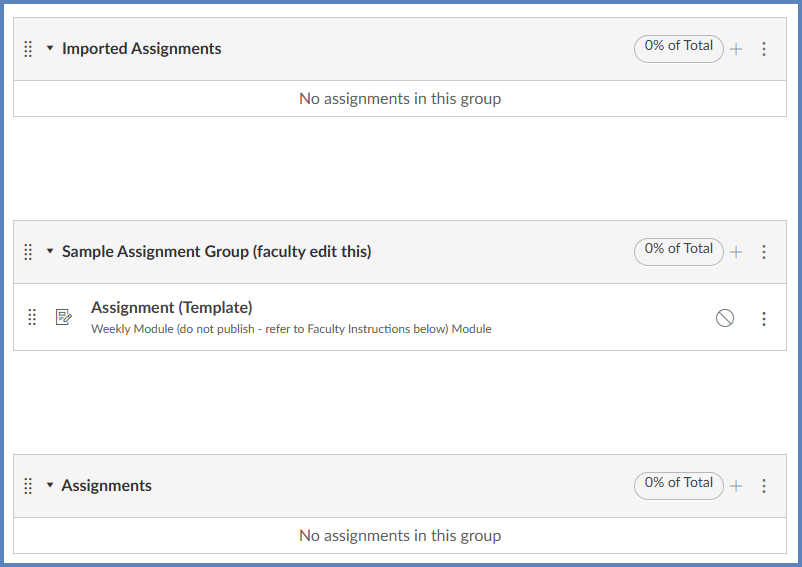
A screenshot of the Canvas Assignments page lists several assignment groups, with dark purple arrows highlighting two unused groups at the bottom. The "Sample Assignment Group (faculty edit this)" and "Imported Assignments" groups are both shown with a "0% of Total" weight, which the arrows specifically point out. Additional arrows indicate the contents of these unused sections: the Sample group contains a single item labeled "Assignment (Template)," while the Imported Assignments group is empty, displaying the text "No assignments in this group." Active groups visible above include "Assignments" weighted at 50%, "Exams" at 35%, and "Discussion Topics" at 15%.

Leaving unused Assignment Groups can confuse students. Even if these groups are empty or contain only unpublished items, they still appear in the student Gradebook. This creates unnecessary clutter, as students will see these group names listed alongside the active assignment categories in their grade summary.
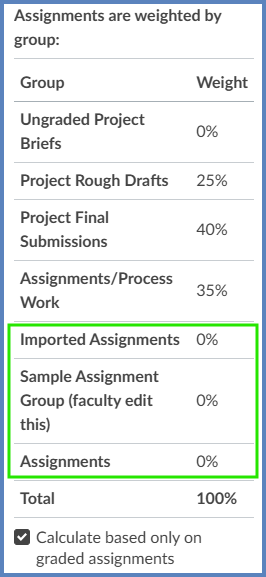
A screenshot of the "Assignments are weighted by group" sidebar in the Canvas student gradebook displays a table comparing assignment groups and their respective weights. The groups listed are "Assignments" (50%), "Exams" (35%), and "Discussion Topics" (15%). Below these active groups, a dark purple box highlights two unused rows: "Sample Assignment Group (faculty edit this)" and "Imported Assignments," both showing a weight of 0%. At the bottom, the "Total" is calculated as 100%, followed by a checkbox labeled "Calculate based only on graded assignments."

In the above example, the unused Assignment Groups are listed for students. They may not know why they are seeing “Sample Assignment Group (faculty edit this)” or they may not know what “Imported Assignments” means.
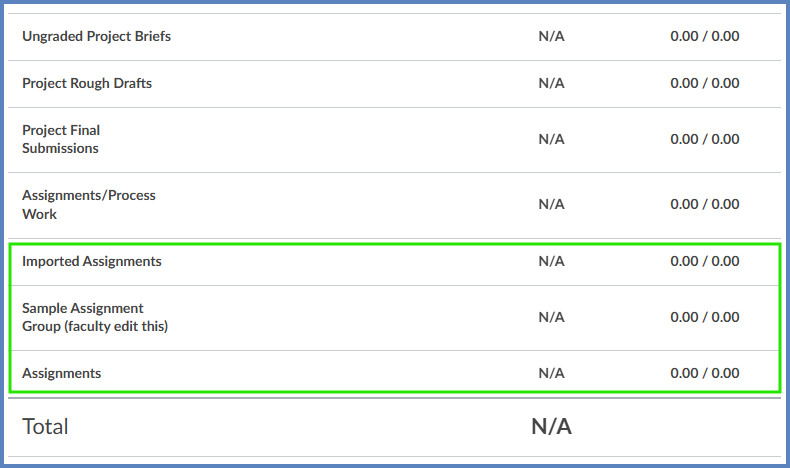
A screenshot of the bottom section of a student's gradebook in Canvas displays a list of assignment groups under the headers "Name," "Due," "Submitted," "Status," and "Score." The standard groups "Assignments," "Exams," and "Discussion Topics" are listed first. Below them, a dark purple box highlights two unused groups: "Sample Assignment Group (faculty edit this)" and "Imported Assignments." All groups currently show a score of "0.00 / 0.00" with a status of "N/A," and the "Total" at the bottom of the page is also listed as "N/A."

Similarly, still in a student’s view of the Gradebook, these same Assignment Group names are listed at the bottom of the screen above the “Total” row.

If you have Assignment Groups that are either empty or won’t be used in your Canvas course(s), it is safe to delete them. This will help:

  • to keep your Assignments page clean and organized.
  • to eliminate those unused Assignment Group columns at the end of your own Gradebook.
  • your students to better understand how their grades are being assessed in your course(s).

Deleting Unused Assignment Groups

  1. Navigate to your Assignments index page of your course in Canvas.
  2. Click click the Options (three vertical dots) icon to the right of an Assignment Group name.
  3. Select 🗑️ Delete to delete the Assignment Group from your course.
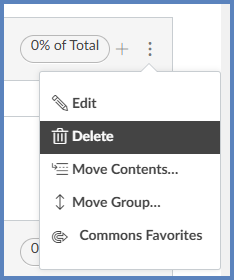
A screenshot of the options menu for an assignment group in Canvas highlights how to remove a group. A yellow circle labeled "2" points to the three vertical dots icon located next to the "0% of Total" badge. The menu is expanded, displaying options such as "Edit," "Move Contents," and "Move Group." A yellow circle labeled "3" specifically highlights the "Delete" option within this list.

Additional Resources

Add an assignment group in a course (Instructor Guide)
View my grades in a current course (Student Guide)

How do I view my grades in a current course?

00:07: How do I view my grades in a current course? 00:10: In global navigation click the courses link then click the name 00:14: of the course. 00:16: In course navigation click the grades link 00:20: From the grades page you can select the course for which you want to view grades. 00:24: By default grades are sorted chronologically by assignment due 00:28: date in the arranged by menu. You can also sort by module assignment 00:32: name or assignment group. To see the specified grades 00:36: click the apply button assignments that are not part of a module will 00:40: be shown at the end of the assignments list in alphabetical order. 00:44: However, if modules are assignment groups aren’t used in your course, they 00:48: won’t be included as sorting options. 00:52: You can view the name of the assignment the assignment due date the assignment 00:56: submission date the assignment status the score you earned and the 01:00: total point value of the assignment. You may also be able to view whether 01:04: the assignment includes scoring details comments or rubrics. 01:10: You may see various great icons in the score column indicating the type of assignment 01:14: you submitted. These assignments have not been graded by your instructor. 01:18: Once the assignment is graded. 01:20: The icon will be replaced by your score. 01:24: To print your grades click the print grades button. 01:28: By default the grades page displays the current grading period if an 01:32: assignment does not include a due date it will display as a part of the last grading 01:36: period To view grades for another course. 01:39: Click the course drop down menu. 01:41: To see the specified grading period and course click the apply button. 01:46: If grading periods are enabled in your course, you can view your grades according 01:50: to grading period 01:53: If your course includes weighted assignment groups assignment groups may vary 01:57: in the sidebar depending on which grading period you are viewing. 02:00: An assignment group displays if the group has at least one assignment due in the selected 02:05: grading period When grading periods are weighted and you select 02:09: the all grading periods option the sidebar displays the weights of each 02:13: grading period grading period 02:17: Your instructor May enforce an automatic late policy in your course any 02:21: assignments that are submitted after the due date are marked as late. 02:25: The late policy automatically deducts a percentage of the grade from the total 02:29: score. Late assignments display the late icon in the status column 02:33: of the gradebook. To view submission details for a late assignment click 02:37: the submission name. 02:47: Some assignments include a black warning icon which alerts you that points 02:51: earned from this assignment will not count toward your final grade. 02:54: You should still submit this assignment unless it has been excused by your instructor. 03:00: If there are comments in your assignment the assignment displays a comment icon. 03:04: To view comments click the comment icon if there are unread 03:08: comments an indicator is displayed once the comments are read the 03:13: indicator disappears. Comments are organized chronologically. 03:19: If there is feedback besides text comments such as media comments, click 03:23: the feedback icon to open the submission details and view the other feedback. 03:29: To close comments. Click the close link. 03:32: If you can view scoring details click the check mark icon. 03:36: You can view the grade distribution for the assignment and view the mean hi 03:40: low median upper quartile and lower quartile 03:44: scores. 03:46: The graphs horizontal line extends from 0 to the assignments highest possible 03:50: score 3 the white box extends from the lowest to the highest 03:54: student scores. Your score appears as a blue square on this 03:58: plot. You will only see scoring details if more than five 04:02: other students have submitted that assignment in the course. 04:05: If you do not see the scoring details then fewer than five students have submitted 04:10: the assignment. To close scoring details. 04:13: Click the close link 04:16: An assignment may also include a rubric icon which means the assignment included 04:20: a rubric for grading purposes. To view your results click 04:24: the icon view your score based on the rubric to close 04:28: the rubric click the close rubric link. 04:32: The grades page will list the assignment groups included in your course. 04:36: Assignment groups allow instructors to organize assignments discussions 04:40: and quizzes into groups and apply specific grading rules or weights to those 04:44: groups. You can view the percentage score for each group in the points. 04:48: You’ve earned versus the total points possible. 04:52: The great summary shows your total grade allows you to view any save what 04:56: if scores and allows you to show or hide all scoring details comments 05:00: and rubrics shown in the grades page. 05:03: Depending on the great calculation for your course your total grade May 05:07: display as a point value or as a percentage. 05:11: Your instructor May restrict you from viewing your total grade. 05:15: The current grade is calculated by adding up the graded assignments according to their 05:19: weight in the course grading scheme. This grade is calculated with the 05:23: calculate based only on graded assignments checkbox selected in the sidebar. 05:29: The total grade is calculated by adding all the assignments according to their weight 05:33: in the course grading scheme both graded and ungraded assignments. 05:37: To view the total grade deselect the sidebar check box the 05:41: grade at the top of the sidebar will reflect your total grade. 05:46: The sidebar shows the information about how your grades are calculated. 05:50: If your assignment groups are weighted, the sidebar will show the breakdown of weighted 05:55: assignment groups. 05:57: Assignment groups will always display as a percentage if your instructor allows 06:01: you to view total grades. You can see a breakdown in the points. 06:04: You’ve earned versus the total points possible. 06:08: If your course does not use assignment groups, your total grade can be displayed in 06:12: points or percentage. If your total grade is displayed in points, 06:16: you can view your overall grade percentage. 06:19: Again, your instructor May restrict you from viewing your total grade. 06:24: If your institution restricts viewing quantitative data, your total grade 06:28: is displayed using a grading scheme usually letter grades. 06:32: Again, your instructor May restrict you from viewing your total grade. 06:37: If you have more than one course you can use the course drop-down menu to view grades 06:41: in other courses. If your grades page shows assignments and 06:45: learning Mastery headings you can also view your standards based scores in 06:49: the learning Mastery link. 06:52: This guide covered how to view my grades in a current course.