
It is important to verify that hyperlinks are working correctly in your Canvas course(s). Canvas includes a tool to scan your course content and check for invalid or unresponsive links in both published and unpublished course content. The link validator also includes deleted links. Deleted links are links that are still in the course, but their linked content has been deleted (such as a course file or page). Finally, the link validator can find links that are pointing to other courses where students would not be able to access that content.
In addition, a link checker tool is included in the DesignPLUS sidebar that lets you know of broken links in real time.
Click on Validate Links in Content on the right side of the screen.
One of two buttons will be visible. If you are scanning your course for the first time, click on the Start Link Validation button. If you have scanned your course before, click on the Restart Link Validation button. Depending on the amount of content in your course, it may take a few minutes for Canvas to scan your course for potential issues with hyperlinks.
When Canvas finishes scanning your course, you will see a listing of course content with links that may need your attention. For example, you may see something like this:
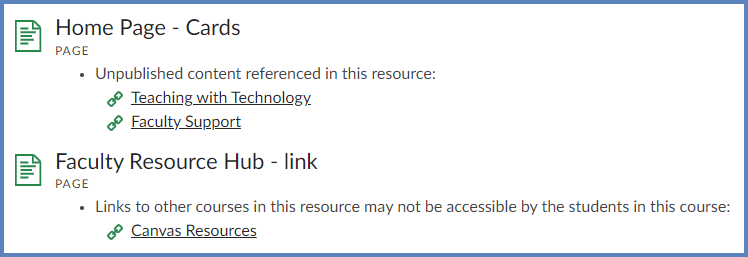
In the above example:
The Home Page – Cards page contains several links. However, Canvas found that two of the links on that page, Teaching with Technology and Faculty Support, are pointing to Canvas content pages that have not yet been published in the course. Therefore, students would not be able to access those two resources in the course.
The Faculty Resource Hub – link page includes a link to a page called Canvas Resources. However, the instructor had copied and pasted the Canvas Resources link from a past semester course to a current semester course. Even though the link appears to work properly for the instructor, it will not work properly for students. This is because the instructor has access to both the past course semester and the current semester course. Students, on the other hand, are not enrolled in both of these courses. When students click on the Canvas Resource link, they will get an error message because the link points to the instructor’s past course. In order to fix links like this, it is recommended to follow the instructions in this Guide vs. copying and pasting links from course to course:
Create hyperlinks to course or group content in the Rich Content Editor
Similarly, if the Link Validator tool were to find broken images in a course, you can use the following Guides to ensure the images are properly linked in the course:
Upload and embed an image in the Rich Content Editor
00:07: How do I upload an embedded image in the rich content editor as a student?
00:12: Open the rich content editor when using one of the canvas features, which support the editor.
00:18: You can upload and embed an image by dragging and dropping from a web browser or
00:22: a file saved to your computer. If you drag and drop an image
00:26: from a web browser The Source URL for the image populates in the file
00:30: URL field in the image options.
00:34: You can upload and embed an image by copying and pasting it.
00:38: To copy an image to your clipboard right? Click the image and select copy.
00:43: You can paste it by right clicking into the Rich Text Editor and selecting paste or
00:47: using the keyboard shortcut Ctrl + V on a PC or command + V
00:51: on a Mac.
00:53: To upload an image from the toolbar click the image icon.
00:57: From the drop-down menu select the upload image option.
01:01: Alternatively, you can embed images from the menu bar.
01:04: Click the insert link navigate to view the image options, then
01:08: select the upload image option.
01:12: By default the image upload tool displays the computer tab click
01:16: or drag and drop an image file to the image uploader to upload a file from your
01:20: computer.
01:22: After uploading your file the uploader displays the image file name and
01:26: an image preview. To remove the image.
01:28: Click the delete icon.
01:31: To upload an image using a URL click the URL tab Enter
01:36: the URL in the file URL field
01:40: To add alt text to your image type an alternative text description or
01:44: text tags in the alt text field.
01:47: By default the alt text field displays the image file name.
01:51: Alt text is read by screen readers and it displays when an embedded image
01:55: cannot display. If the image is decorative and does not require, alt
01:59: text click the decorative image check box.
02:03: By default the embed image display option is selected for embedded
02:07: images. To display the image file link select the display
02:11: text link display option 4 the file link will
02:15: replace the image in the rich content editor.
02:19: To embed your selected image. Click the submit button.
02:23: View your uploaded image in the rich content editor.
02:25: You can also add alt text tags and manage the image display options.
02:31: To manage image options from an embedded image file.
02:33: Click the image then click the image options link.
02:37: You can manage display options for embedded images in the image options menu.
02:42: You can manage the image, alt text the image size and other display
02:46: options. To replace or update an image added via URL
02:51: enter an updated image URL in the file URL field.
02:55: Click the done button.
02:58: View the content created in the rich content editor.
03:02: This guide covered how to upload an embed an image in the rich content editor as
03:06: a student.
Embed images from Canvas into the Rich Content Editor
00:00:How do I embed images from Canvas into the Rich Content Editor as a student?
00:05:Open the Rich Content Editor when using one of the Canvas features which support the Editor.
00:11:Click the Image icon.
00:14:To view images saved in your Canvas user files, select the User Images option.
00:20:Alternatively, you can embed images from the menubar. Click the Insert link.
00:25:Navigate to view the Image options, then select the User Images option.
00:31:By default, when embedding an image in the Rich Content Editor, the Add menu displays image files from your selected source.
00:39:To change the image file source, click the Source drop-down menu.
00:44:To sort image files by date added or alphabetically, click the Sort by drop-down menu.
00:51:To search for an image, enter the file name in the Search field. You must enter at least three characters for search results to display.
01:00:Click the image file to embed.
01:03:View the image embedded in the Rich Content Editor. You can also edit the size of the image and add alt tags for improved accessibility.
01:12:Click the Reply or Save button.
01:15:View the content created in the Rich Content Editor.
01:19:This guide shows how to embed images from Canvas into the Rich Content Editor as a student.
DesignPLUS Link Checker
Alternatively, if you are comfortable using the DesignPLUS sidebar in your Canvas course(s), you can use their Link Checker in a similar manner.
NOTE: Compared to the Canvas Link Validator, the DesignPLUS Link Checker only scans one page at a time.
Edit a content page in your Canvas course.
If the DesignPLUS sidebar is not visible on the right side of your screen, click the 🚀 rocketship icon in the upper right corner of the screen.
Alternatively, press the keyboard combination Alt/Option + Shift + D.
Click on the Accessibility / Usability tab at the top of the DesignPLUS sidebar.
Under the Accessibility heading, click on the 🔗 Link Checker button.